On the Journey to Hartford
Updated: Jan 29
A house that possessed a heart and soul, and nurtured an author.
This past Fall, I had the pleasure and privilege of going on a behind-the-scenes tour of the Mark Twain House & Museum in Hartford, Conn. Twain's home is a place where contemporary voices are celebrated, diversity is not a dirty work, women aren’t scorned for being intelligent and outspoken...and all this was true during the author's residence there. I imagine if Twain were alive today, he would be hosting a late night show, gleefully skewering politicians and poking fun at evangelicals. He would get cancelled faster than Jimmy Kimmel.
Mark Twain’s Adventures of Huckleberry Finn remains at the top of the list of most popular books to ban. The novel that follows the adventures of a homeless boy who helps a runaway slave escape has been decried as being both racist and radical. The author would've found this honor endlessly amusing, as he did whenever he came across absurdity in human nature or people who didn’t appreciate or comprehend satire.
From Samuel Clemens's notebook #35, On The Adventures of Huckleberry Finn: "A book of mine where a sound heart and a deformed conscience come into collision and conscience suffers defeat."
At this point in our country’s devolution, we could benefit greatly from a good dose of Twainian insights washed down with humor. Of course, to truly digest and gain benefits from his particular brand of wisdom, we would have to be willing to read more than a few lines on a social media post or even a meme with a Twain quote. Granted, he was great at one-liners. But his real genius comes through in his storytelling.
As I stood in front of the desk where Mark Twain penned his greatest works, it struck me that he was very aware of the power of his words--to entertain, inform, influence, and even change the way people thought about society and each other.

In the same way, I want the words I string together into stories to do more than simply entertain. I want the books I write to create a place where readers can connect with all sorts of characters, and with themselves.
Through stories, we confront our fears and foibles, our fragile hopes and our fantastic dreams. When we travel with characters through their adventures, we can learn from them. That is partly what Mark Twain taught me. He also advised not to trust politicians. Wise words indeed.
For you, my dear readers, I wanted to share a few photos and stories I collected while on a tour of the famous author's family home.
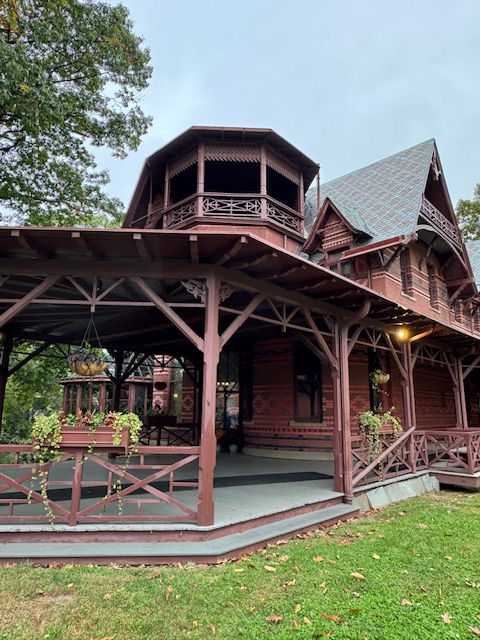
This house, custom built for Samuel Clemens and his wife, Olivia, is unlike any other house I've ever seen. It was designed by Edward Tuckerman Potter. Oddly enough, Potter was best known as an "ecclesiastical specialist." In other words, he designed churches (particularly Episcopal churches).
Samuel Clemens was famously irreligious. I can’t imagine the self-professed sinner wanted his home to look like the inside of a church. I will say, however, this place became for him both a sanctuary and an altar. He described it with nearly religious zeal:
“To us, our house…had a heart, and soul, and eyes to see us with; and approvals and solicitudes and deep sympathies; it was of us, and we were in its confidence and lived in its grace and in the peace of its benediction.” ~ Mark Twain
Over fifteen years, the Hartford house observed the happiest times and the saddest times in the life of the author who lovingly praised its sentient qualities.

The house has been meticulously restored as close to possible to what it looked like when the Clemens family lived there.
Sam and Livy raised three daughters in this home. The girls' favorite spot was the Conservatory, which they called "the jungle." Every wealthy family of the period had one. Theirs featured a blissful fountain.
I am drawn to water features. I have three in my yard. If I could bring my yard into the house, I'd have one inside too.
One of my favorite stories concerns the Library mantle. The ornate oak mantlepiece was purchased from a castle in Scotland. Was Twain imagining himself as the king of his castle? A Connecticut Yankee in King Arthur's Court? I'll spare you more puns and tell you a story instead.

The Library was where Sam and Livy would entertain family and friends. He might read a passage from one of his books or manuscripts. He would often tell impromptu stories using the items on the mantle shelf. Being a game, it had rules one must follow.
When spinning a tale, the author had to use every item on the mantel shelf in order. Once completed, he would tell another story. But he was not allowed to repeat elements of previous stories. He had to tell a new story using all the items in order in a different way. Do not try this at home!

My favorite item is a portrait of a cat wearing a 16th century "ruff." How would Mark Twain have used the fanciful feline in his stories? I would guess he found ways to present the cat favorably.
Mark Twain is often photographed with cats, and in ways that make it appear they are his companions more than pets. He admired cats. In fact, he may have esteemed cats over the human species.
If man could be crossed with the cat, it would improve the man, but it would deteriorate the cat. ~ Mark Twain
Sam Clemens adored his children. He originally planned to set up his writing room next to the nursery where the girls spent most of their time playing and being tutored. As you can imagine, that setup didn’t work out very well.
The author moved upstairs to the billiards room to work. He put a desk and a writing table near the window.

At the desk, he took care of business
correspondence. He wrote at a small table facing the wall to avoid being tempted with distractions.
His work in progress would go into a file cabinet with cubby holes. There the projects would remain until one was ready for him to pick it up again. Some works took years to complete. He started The Adventures of Huckleberry Finn in 1876, but didn't finish it until 1884.
I understand completely what he meant about stories needing to undergo a fermentation period. I worked on my two novels featuring Tom and Huck as adults for over ten years.
Let us leave the billiards room and go downstairs to Sam and Livy's bedroom. I want to share a story that really illustrates not only Twain’s humor, but also that of his closest companion and partner, his wife. Allow me to set the stage:

Olivia was in bed reading. Sam was in the closet putting on a shirt. The closet was a place where he felt free to cuss because he could shut the door and not offend his wife.
Sam becames frustrated with how poorly the shirt fit, and in a rage heaved the shirt out an open window, followed by a stream of colorful curses.
Just about the time Sam calmed down, he noticed the door to the closet slightly open. Gads! Had Livy heard him? Now, you need to know that Sam had promised his very proper wife that he would cease his bad habits, one of them being cussing. He stood there for a moment, very quiet. After he didn’t hear her say anything, he thought perhaps she had left the room or hadn’t heard him.
He sheepishly slipped back into the bedroom. Olivia was still in bed, reading. Without looking up, she calmly repeated his obscenity-laced temper tantrum word-for-word. He immediately begged for forgiveness and promised never to cuss again. She rolled her eyes.
Livy had a pet name for Sam. Youth. I won't unpack that. You can figure it out, or buy one of the books about their life together from the museum bookstore.
My thanks to MTH&M Director of Interpretation Rebecca Floyd for taking me on this very special tour and sharing these wonderful stories.
In February 2022, Rebecca interviewed me for an author spotlight. I talked about what inspired me to write stories about Tom Sawyer and Huckleberry Finn, how I came up with ideas, and the research I undertook to ensure my work would honor the characters Twain created. You can watch the interview in the video below. Rebecca guides us on an after-hours tour of the museum while we are talking. Check it out!


Comments